CRM Software Development: A Complete Guide for Businesses in 2026
Customer relationships become difficult to manage when information is spread across spreadsheets, inboxes, messaging platforms and disconnected business systems. Sales teams need to know who owns each lead, which opportunities require follow-up, what has already been discussed with a prospect and how deals are progressing. Managers need reliable reporting, while operations teams may need customer information to connect with wider processes.
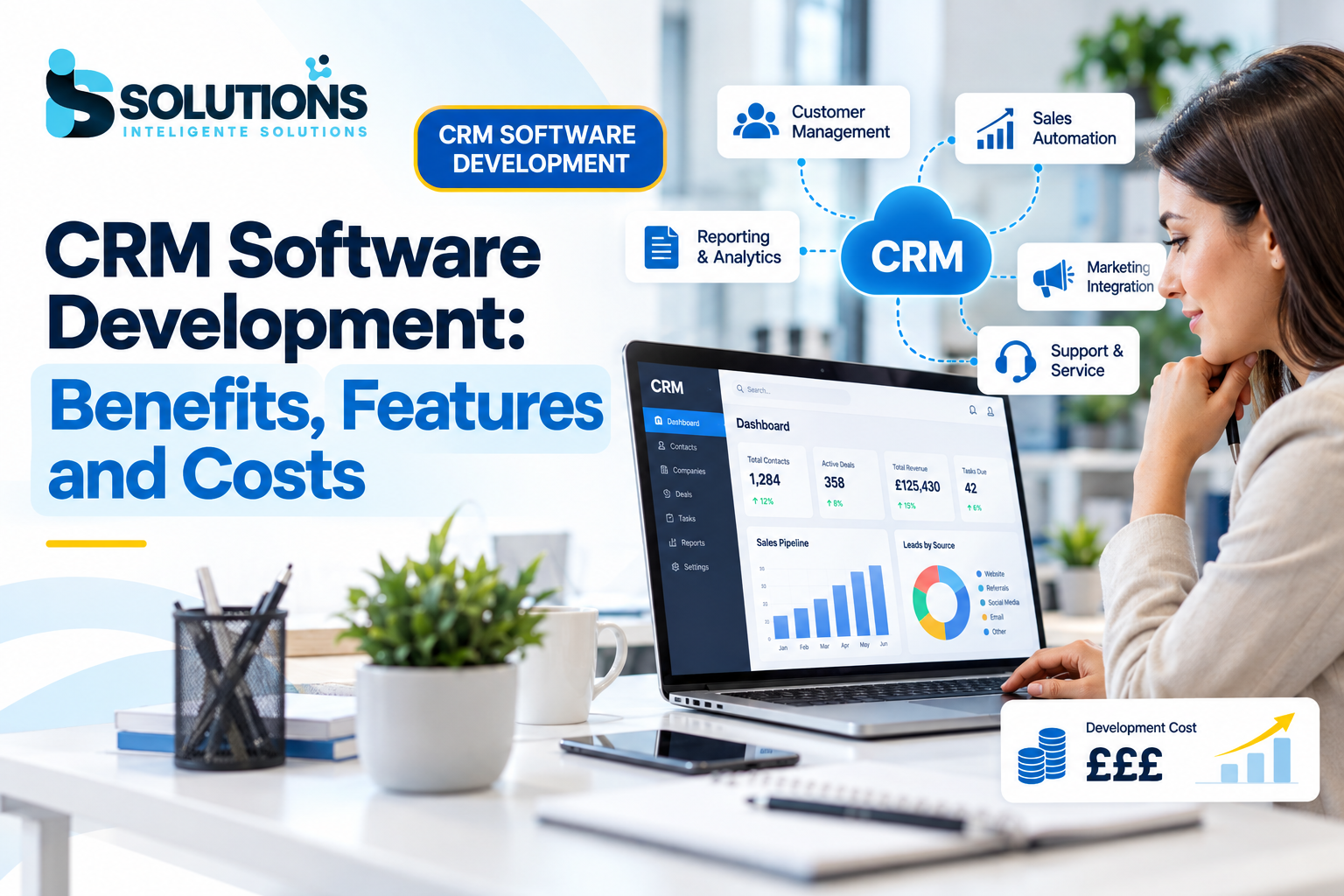
A modern CRM is therefore much more than a digital address book. It can bring together customer information, leads, sales pipelines, communications, follow-ups, reporting, automation, permissions, dashboards and integrations within a structured working environment.
CRM Software Development is the process of creating or adapting customer relationship management software around defined business requirements. For organisations whose processes cannot be represented efficiently in a standard product, custom CRM software development can provide greater control over workflows, data structures and integrations. Businesses considering this route should first understand what CRM software development actually needs to solve before deciding how the technology should be built.
What Is CRM Software Development?
CRM development involves designing software that helps an organisation manage relationships with prospects and customers throughout their lifecycle. Depending on the business, this can include lead capture, contact records, opportunity management, sales stages, communication histories, scheduled follow-ups, workflow automation, dashboards, reporting and role-based access.
The important distinction is between configuring an existing CRM and developing a system around specific requirements. A subscription platform provides a predetermined product that can usually be configured within defined limits. A custom system starts with the organisation's workflows, data and operational requirements, then designs functionality around them.
Neither approach is inherently superior. A company with conventional sales processes may obtain everything it needs from an established platform. Another organisation may have specialist approval chains, unusual customer journeys or connections with existing systems that make custom development more practical.
The right CRM software features are therefore determined by how people actually work. A technically impressive system can still fail operationally if salespeople must perform unnecessary steps, managers cannot obtain meaningful reports or important customer information remains outside the CRM.
Custom CRM Software Development: Why Off-the-Shelf Tools May Fall Short
Standard CRM products are attractive because they can be deployed without building an entire application from the beginning. For businesses with relatively conventional requirements, this can be the sensible commercial choice.
Limitations become more significant when an organisation has unusual workflows, industry-specific processes, complex approval chains, specialist reporting, custom permissions or existing software that needs to exchange information with the CRM. Teams can eventually find themselves adapting their processes to suit the product rather than using technology that supports the way the business operates.
That is where custom software development becomes relevant. Instead of treating customisation as an objective in itself, the development process should identify the specific operational problems that cannot be handled efficiently through configuration of an existing platform.
A professional-services company, for example, may need a relationship model centred on enquiries, consultations, proposals and long-running client engagements. A sales organisation may instead prioritise opportunity stages, deal ownership, forecasting and automated follow-ups. Both require customer relationship management, but their workflows can be substantially different.
Custom development makes most sense when this additional control solves a genuine business problem. Building bespoke software simply because it is possible usually adds unnecessary cost and responsibility.
CRM Software Features That Actually Matter
Useful CRM functionality normally begins with reliable customer and lead records. Teams need to understand who a customer is, what interactions have taken place, who owns the relationship and what action should happen next. Sales pipelines can then organise opportunities around meaningful stages rather than leaving information scattered across individual spreadsheets.
Automation should remove repetitive work without obscuring important decisions. Follow-up reminders, task creation, notifications and workflow triggers can reduce manual administration, while dashboards and reporting can help managers understand pipeline activity and team performance.
Permissions become increasingly important as more people use the system. Sales representatives, managers, administrators and other departments may require different levels of access. API integrations may also connect the CRM with websites, communication services or other business applications.
Customer information can sometimes need to interact with operational data. For example, a company selling physical products may benefit from connecting customer and sales processes with inventory management software. That does not mean inventory functionality belongs inside every CRM; it means the architecture should account for the systems that genuinely need to exchange information.
Similarly, sales and customer records may need controlled connections with custom accounting software where financial workflows require relevant data to move between systems. Integration requirements should be established during discovery rather than added casually after development.
CRM Software for Small Business
Smaller organisations often benefit most from clarity rather than feature volume. A useful CRM software for small business can centralise contacts, organise leads, record customer history, manage follow-ups and provide enough reporting for owners or managers to understand what is happening.
Small does not necessarily mean simple. A ten-person company can still have several customer journeys, multiple approval stages, specialist reporting requirements or complicated relationships between sales and delivery. The CRM should reflect the actual process rather than assumptions based on headcount.
Usability is particularly important when employees have several responsibilities. If maintaining the CRM becomes another administrative burden, data quality can deteriorate quickly. The system should make important actions straightforward and avoid requiring users to navigate functionality that has little relevance to their work.
Growth should also be considered during planning. This does not require building enterprise complexity into a small-business system from day one. It means making sensible decisions about data structures, permissions and architecture so foreseeable changes do not immediately require the application to be rebuilt.
How Much Does CRM Software Development Cost in 2026?
There is no responsible universal price for custom CRM development. The CRM software development cost depends on what the organisation actually needs the system to do.
A relatively focused application containing customer records, lead management and a straightforward sales pipeline is fundamentally different from a multi-department platform with complex permissions, extensive automation, specialist reporting, data migration and several external integrations.
UI and UX requirements influence effort because a CRM is an operational application that employees may use throughout the working day. Data migration can also become a substantial part of a project when existing information must be cleaned, mapped and transferred from spreadsheets, legacy databases or another CRM.
Integrations introduce further technical considerations. APIs, authentication methods, synchronisation rules and failure handling all require planning. Mobile requirements, infrastructure, security controls, testing, maintenance and post-launch support can also affect the overall scope.
The current Inteligente Solutions website similarly states that custom software pricing depends on scope, complexity and required integrations, with a tailored quotation following initial requirements discussion rather than a universal advertised development price.
CRM vs ERP Software: What's the Difference and Which Do You Need?
The distinction between CRM vs ERP software is primarily about the business processes each system manages.
CRM focuses principally on prospects, customers, sales activity, communications and relationship processes. ERP covers a broader operational environment and may include areas such as finance, inventory, supply chain, HR and other internal business functions.
Neither category is universally better. A sales-led organisation may need CRM without a full ERP. Another business may have substantial operational requirements that make ERP central to its technology environment. Larger or more operationally complex organisations may need both.
Where broader operational management is required, custom ERP software can sit alongside CRM rather than being treated as a replacement for customer relationship management.
When CRM and ERP Work Together
Connected CRM and ERP environments can reduce the need to maintain the same information manually in several systems. Sales teams may work primarily with customer and opportunity data while finance, inventory or operational teams use systems designed around their own responsibilities.
The objective should not be to combine every process into one enormous application. It should be to decide which system owns which information and where controlled data exchange improves the workflow.
HRM, accounting and inventory applications can form part of this wider software environment where business requirements justify them. They should not be added to a CRM simply to increase its feature list.
Cloud-Based CRM Development and Modern Architecture
Cloud-based CRM development can allow authorised users to access centralised information from different locations and devices, depending on how the application is designed and deployed. This can be useful for distributed sales teams, managers working across locations and organisations that need central access to customer information.
Cloud architecture also introduces decisions about hosting, databases, deployment, backups, integrations, monitoring, access management and application performance. Scalability should be considered according to realistic growth expectations rather than treated as an unlimited property of cloud hosting.
Security requires particular care. Moving a CRM to cloud infrastructure does not automatically make the application secure. Security depends on architecture, configuration, authentication, permissions, development practices, data handling, monitoring and ongoing maintenance.
Technology choices should follow requirements. The current Inteligente Solutions site lists backend technologies including Node.js, Python, .NET Core, PHP and Java, alongside React.js, Angular and Vue.js for frontend work, databases including PostgreSQL, MySQL and MongoDB, and AWS and Microsoft Azure among its infrastructure technologies. That does not mean every CRM requires the same stack.
Enterprise CRM Software Development
Enterprise CRM software development introduces organisational complexity as much as technical complexity. A large CRM may serve several departments, business units, management levels and user groups, each with different responsibilities and information requirements.
Permissions consequently need more detailed planning. Data visible to an individual salesperson may differ from information required by a regional manager, administrator or executive. Reporting may need to combine information across teams while maintaining appropriate controls.
Enterprise projects can also involve legacy applications, large existing datasets, multiple integrations, custom dashboards and more demanding workflow automation. Audit requirements, availability expectations and data architecture become increasingly important as the CRM becomes embedded in core operations.
The challenge is not simply supporting more users. It is designing a coherent system around a more complicated organisation.
The CRM Software Implementation Process
A sound CRM software implementation process begins before development. Discovery should establish business objectives, existing workflows, pain points, user groups, customer journeys, reporting needs and the information the system will manage.
Requirements can then be translated into workflow maps, functional specifications and technical architecture. UI and UX planning should consider how employees will perform common tasks rather than concentrating only on how screens look.
Development follows the agreed requirements, including integrations and data handling where required. Existing customer information may need cleaning and migration, particularly when records come from inconsistent spreadsheets or legacy applications.
Testing should cover functionality, permissions, workflows, integrations and relevant performance or security considerations. User acceptance is equally important because people who understand the operational process can identify issues that purely technical testing may miss.
Training, deployment and post-launch support complete the implementation cycle. Inteligente Solutions currently describes its own broader development workflow through discovery, planning, UI/UX design, development, testing, and launch and support, reinforcing the importance of treating implementation as a staged process rather than simply a coding exercise.
How to Choose a CRM Software Development Company
Selecting a CRM software development company requires more than comparing technology lists. The first question is whether the provider understands the business problem well enough to translate it into sensible software requirements.
Discovery quality matters because weak requirements create expensive ambiguity later. Businesses should examine how a provider approaches architecture, UI and UX, integrations, testing, security practices, documentation, communication and post-launch support.
A portfolio can help demonstrate the types of work a provider has undertaken, although it should be assessed carefully rather than treated as proof that every future project will produce the same outcome. Reviewing past software development projects can provide useful context when evaluating the breadth of a prospective partner's work.
The current Inteligente Solutions homepage also presents an Enterprise CRM Development example addressing sales leads previously tracked across scattered spreadsheets. The described solution included a custom CRM with visual deal boards, automated follow-up triggers and analytics dashboards, using Node.js, React.js and PostgreSQL.
When to Hire CRM Software Developers
A business may need to hire CRM software developers when configuration of an existing platform can no longer address its requirements efficiently. Typical reasons include specialised workflows, unique data structures, custom reporting, integrations with existing applications or automation that requires development rather than standard configuration.
The decision should consider long-term ownership as well as immediate functionality. Custom applications require maintenance, testing and technical support as operating systems, dependencies, APIs and business requirements change.
The right developer or team should therefore be assessed against the project's actual technology and business requirements. CRM experience is useful, but understanding data modelling, application architecture, integration design, usability and maintainability can be equally important.
Building a CRM Around Your Business With Inteligente Solutions
Inteligente Solutions currently positions itself as a technology partner for startups, SMEs and enterprises, with services spanning custom software, CRM and ERP solutions, websites, mobile applications and related digital services. Its software catalogue also covers a range of operational management systems.
That positioning is relevant to CRM projects because customer relationship management rarely exists in complete isolation. A business may initially require a focused CRM and later discover legitimate connections with finance, inventory, HR or another operational application.
The important point is not how many systems can be built. It is whether the proposed CRM addresses the organisation's real customer and sales processes without unnecessary complexity.
Choosing a CRM Development Approach With Inteligente Solutions
Before development begins, the organisation should be able to explain the business goals behind the CRM. Current workflows, customer journeys, team responsibilities, existing data, required integrations, reporting expectations, security considerations and foreseeable growth should all influence the specification.
Budget should also be considered alongside scope. Removing low-value functionality can be more sensible than compromising the quality of important workflows. Likewise, implementation and support requirements should be discussed early rather than treated as problems for the end of the project.
This business-first approach is consistent with Inteligente Solutions' approach to software development, where its current site describes engagements as beginning with an understanding of business goals before technology is designed around them.
Good discovery does not eliminate every change during development, but it reduces avoidable uncertainty. It gives both the business and the development team a clearer basis for deciding what the CRM should do, what it should connect with and how success will be assessed.
Conclusion
CRM Software Development is a business decision as much as a technical one. The starting point should be the organisation's customer journey, workflows, data and operational problems rather than a predetermined technology stack.
Custom development can be valuable when specialist workflows, integrations, permissions or reporting requirements exceed what a standard product can handle efficiently. Off-the-shelf CRM remains entirely appropriate where requirements are conventional and configuration provides sufficient flexibility.
Cost depends on scope and complexity. CRM and ERP address different but potentially connected areas of the organisation, while cloud and enterprise implementations introduce additional architectural and operational considerations. Whatever approach is chosen, careful discovery, implementation planning and developer selection matter.
Where those requirements align with its verified custom software and CRM capabilities, Inteligente Solutions may be a relevant development partner to consider. The appropriate decision should ultimately be based on the organisation's requirements, technical constraints, budget and long-term software strategy.